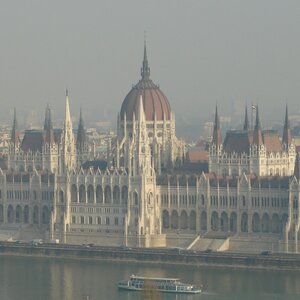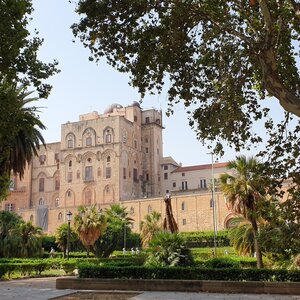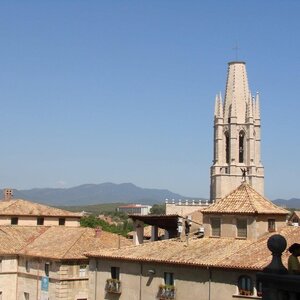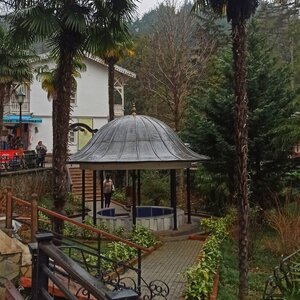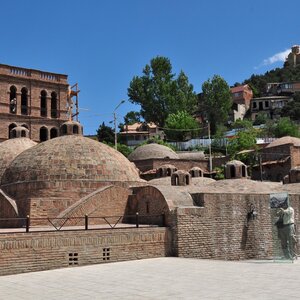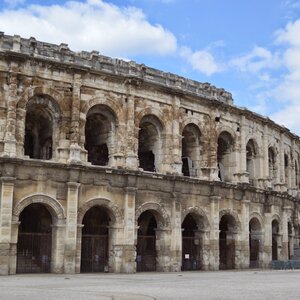
In addition to the beaches with the honorary «Blue Flag», awarded for their cleanliness and safety, there are buildings from the ancient Greeks, Romans, Venetians and Austro-Hungarians. So, stock up on a pair of sneakers and let’s go!
To ensure that walking around the local attractions doesn’t make you uncomfortable, here are some tips.
- In high season (July-August), the city is hot despite its moderately hot climate, so long walks and excursions are better planned for the morning and evening.
- There are car rental services at Pula airport and in the city itself. It will come in handy to see the peninsula — public transportation in Istria is not very well developed. How Istria’s buses work
- Many streets in the city’s historic districts with most attractions are closed to automobile travel, so plan to walk there.
- The most common way to get around the city is by bus, but it doesn’t always follow the schedule exactly. This is a peculiarity of the Croatian mentality, don’t worry.
- Tap water is suitable for drinking.
- 1 Croatian kuna (HRK or Kn) is equal to 0.13 €.
Roman Amphitheater (Arena, Divić-grad)
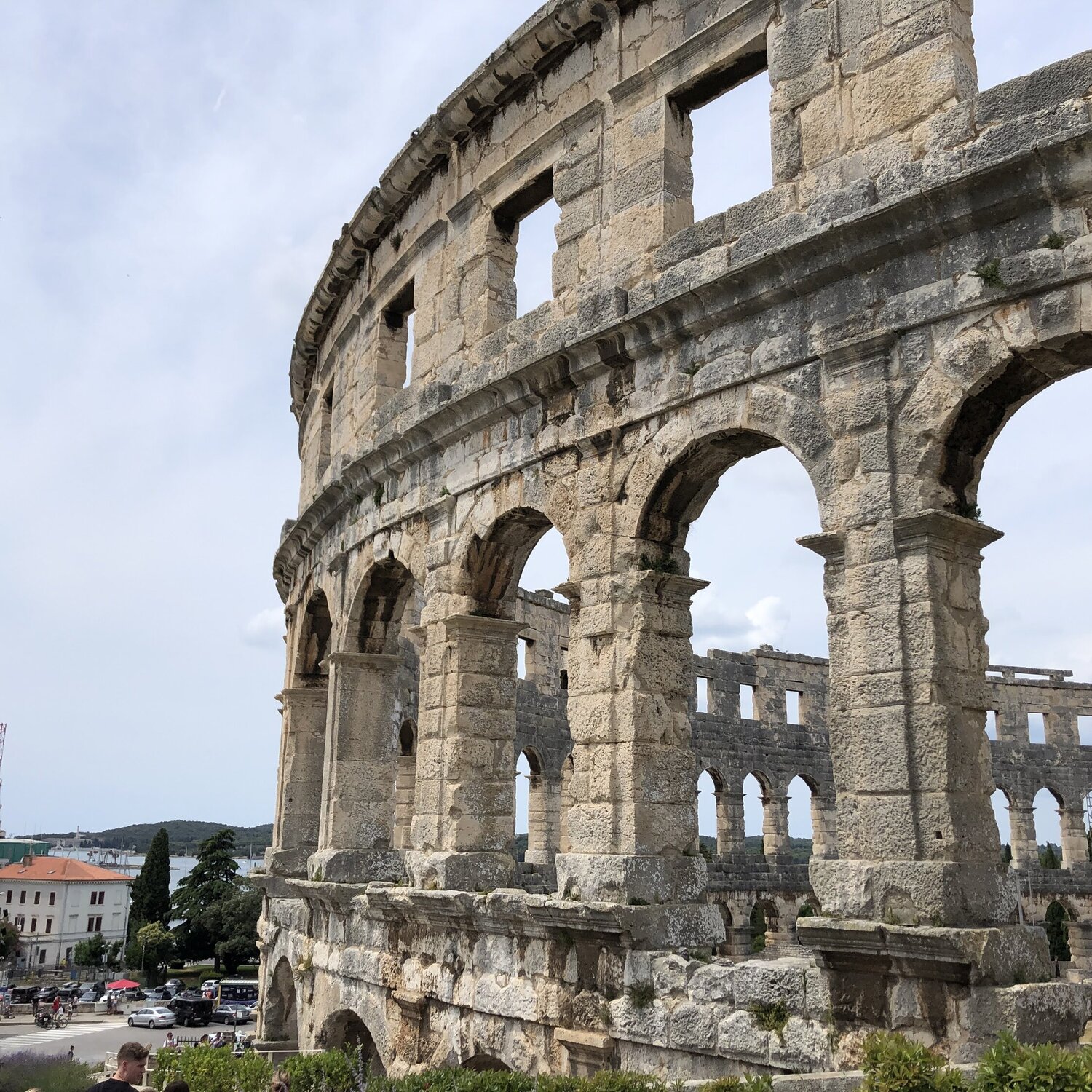
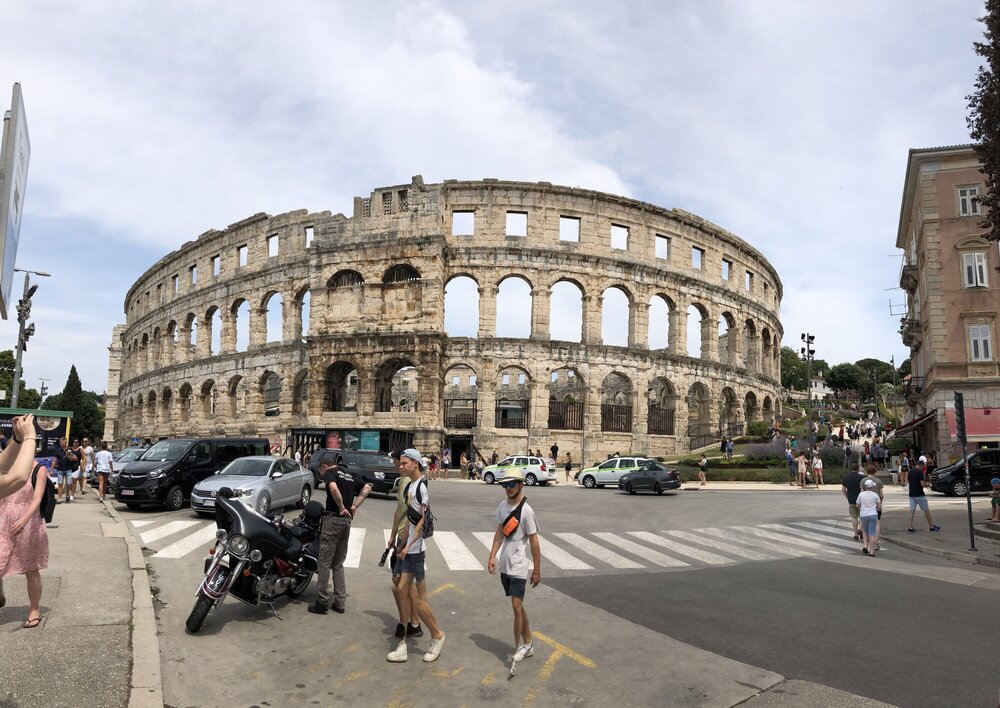
In Pula, all tourist roads lead to the Arena. If you have seen the Roman Colosseum, the Pula Arena will not impress you with its size, but it is the 6th largest and best preserved amphitheater in the world and the main attraction of the city. This majestic structure is the only surviving arena with 4 towers and 3 Roman architectural orders (the order of construction, the composition of horizontal and vertical lines).
This powerful elliptical limestone structure with 29.4 m high walls is located at the edge of the city center. It was built in 68 AD, at the same time as the Colosseum in Rome.
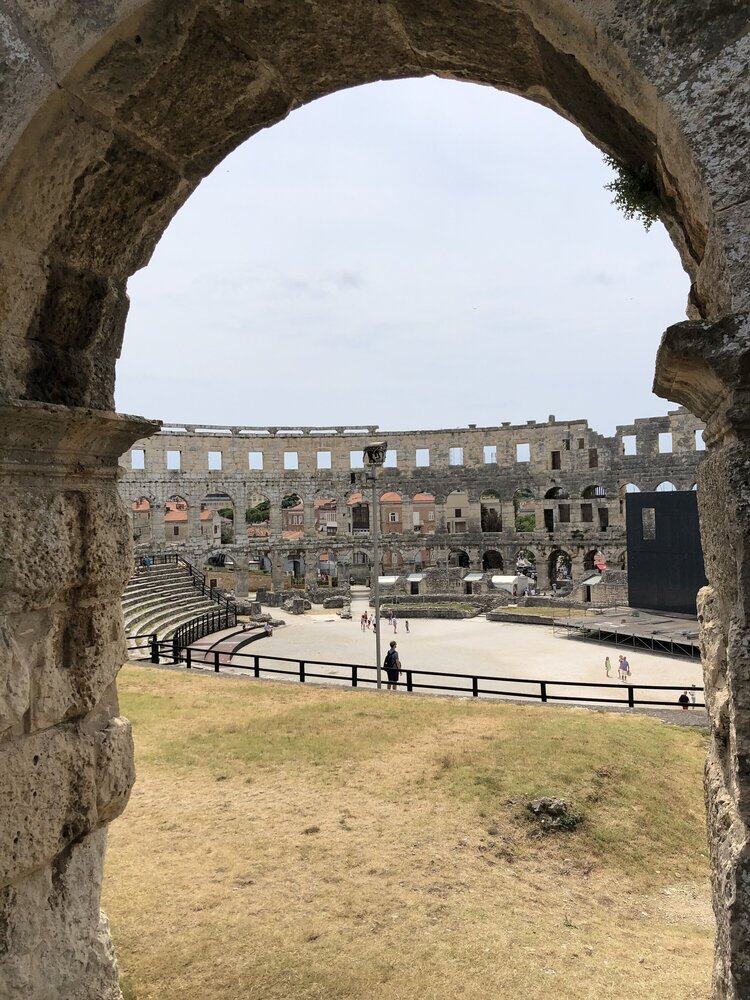
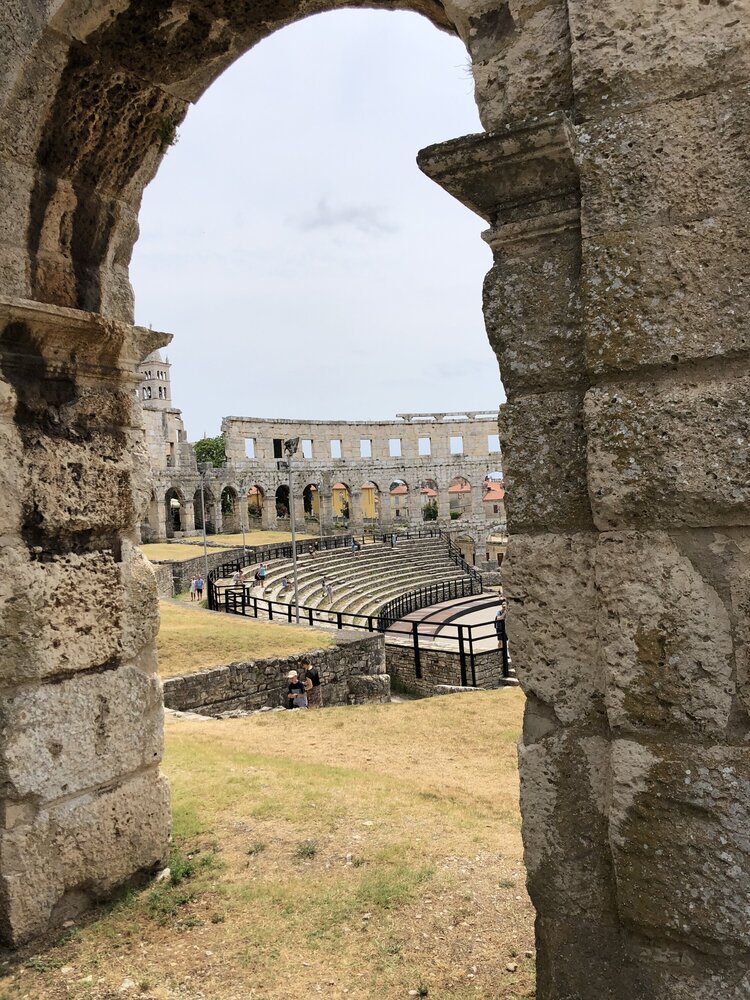
In 1932 the amphitheater was completely reconstructed and equipped for concerts and festivals. In Roman times, the arena could seat up to 20,000 spectators, and now it seats up to 5,000.
Unlike the Colosseum, from the outside of which it is impossible to look inside, Pula’s Arena is almost completely visible, all around the perimeter. But the spectator rows are not the main thing about amphitheaters. Visitors who buy a ticket inside can walk through its underground passages, see the cisterns for supplying spectators with scented water through fountains and stroll through the museum. If you are not interested in all this, the arena can be viewed from the outside.
- The amphitheater’s opening hours are 8:00 — 23:00.
- The cost of adult entrance ticket to the arena is 10 €, children’s ticket is 5 €.
- Arena website
Kaštel Fortress (Kaštel)
Pula’s second iconic landmark, after the Arena, is the castle, or Kastel. The bastion is located in the very center of the Old Town — on the hill around which the city was built. The fortress was erected in the 17th century on the site of ancient Byzantine structures. It is located 34 meters above sea level on a hill, so it offers a panoramic view of the city and the sea.
The fortress, which has survived to this day, was built according to the project of French military engineer Antoine de Villas, one of the first theorists of the bastion system of fortification. He designed it in the form of a star with 4 bastions at the corners and a castle with a tower in the center. The whole complex served as a powerful defense against invasion from the sea. In the twentieth century, the Austrian army heavily rebuilt the fortress, and in the twentieth century, after World War II, the Yugoslav army was stationed here.
Since 1960 the fortress opened its doors as the Historical and Maritime Museum of Istria (Povijesni i pomorski muzej Istre). Here you can see 18 collections with more than 100 thousand exhibits about the history of shipbuilding and naval science. In summer the castle often hosts shows, concerts and other entertainment events.
- The museum is open October through March from 9:00 am to 5:00 pm and April through September from 9:00 am to 9:00 pm.
- The price of the entrance ticket is about 3 €. Children over 5 years old — about 1,5 €, under 5 years old and people with disabilities — free of charge. More information on the museum’s website.
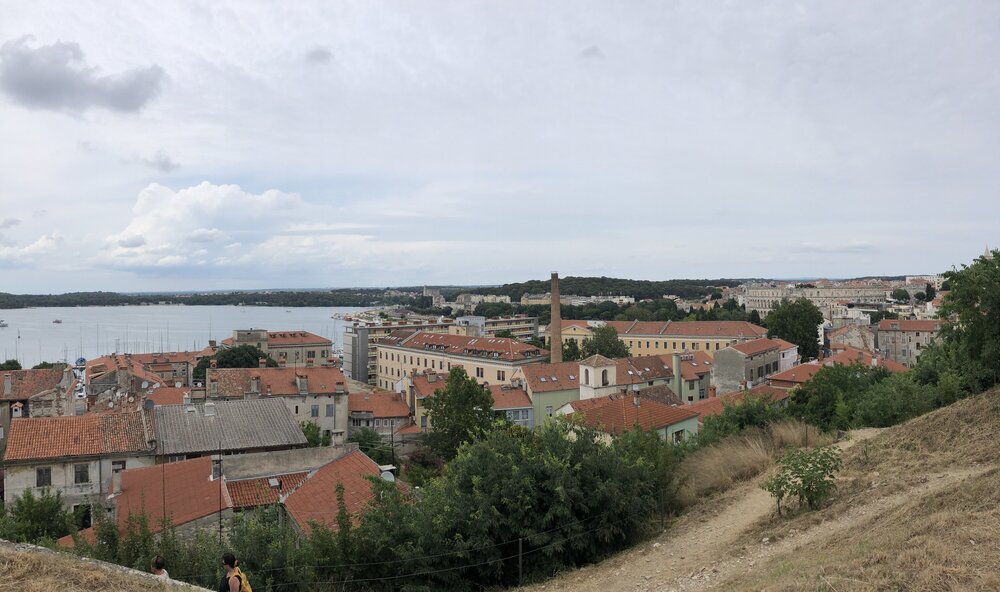
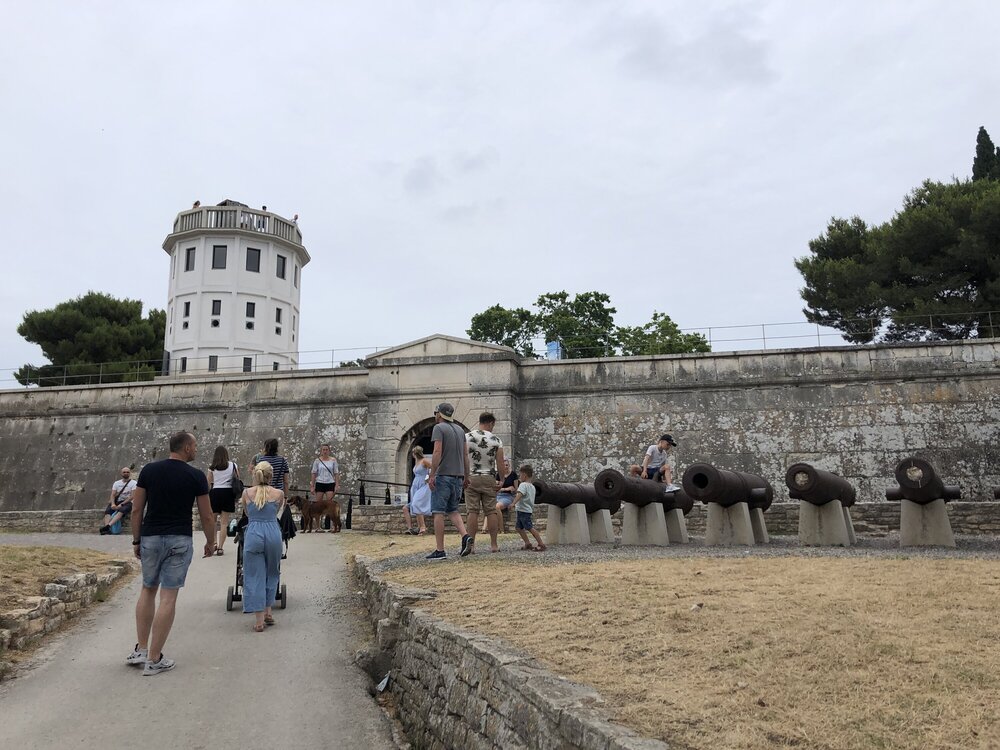
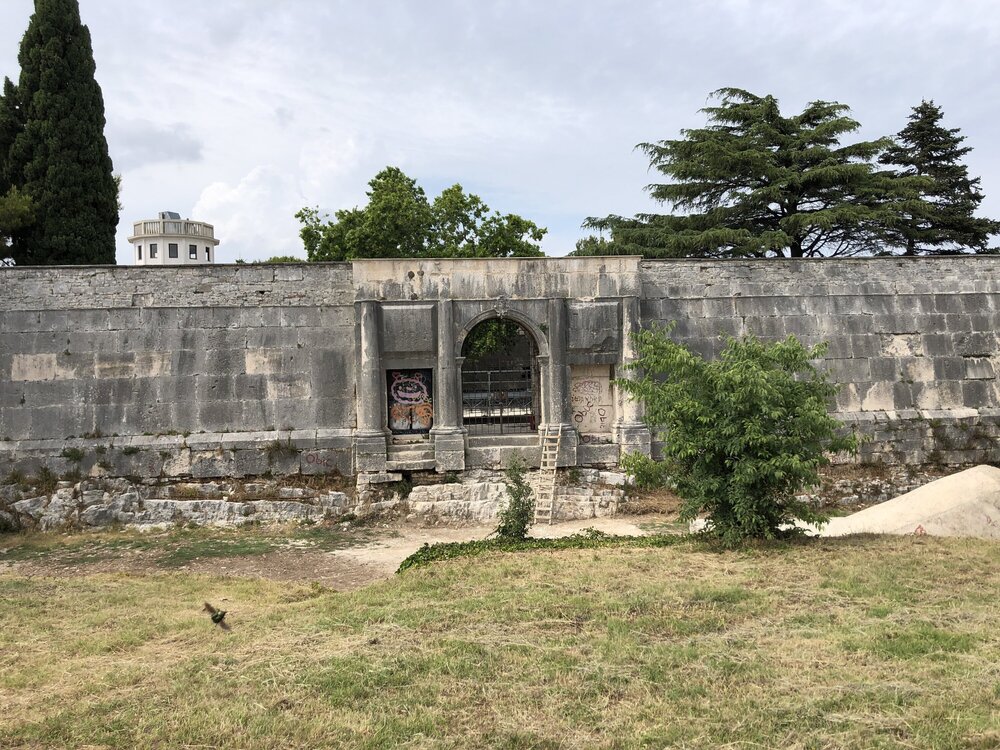
Pula Cathedral (Katedrala Uznesenja Blažene Djevice Marije)
The Church of the Ascension of the Virgin Mary is the main religious attraction in Pula. It is a modest, ascetic building with its own spiritual atmosphere. The interior decoration is not excessive or pompous.
The cathedral was first built here in the 5th century, believed to be the site of the first Christian meetings in Pula. The modern appearance of the building is the result of its reconstruction in the 15th century. Later, the sacristy and bell tower were added to the church. The facade in the style of classicism was built in 1712. The last restoration works date back to 1947.
The cathedral is conveniently located for walking tours and is not far from the amphitheater and the Temple of Augustus.
- If you are vacationing in Pula during the high season, you can take a break from the scorching sun in the coolness of the temple.
- To experience the atmosphere of the cathedral, attend Mass, the schedule of which can be found on the temple’s website.
- Live music concerts are often held near the cathedral.
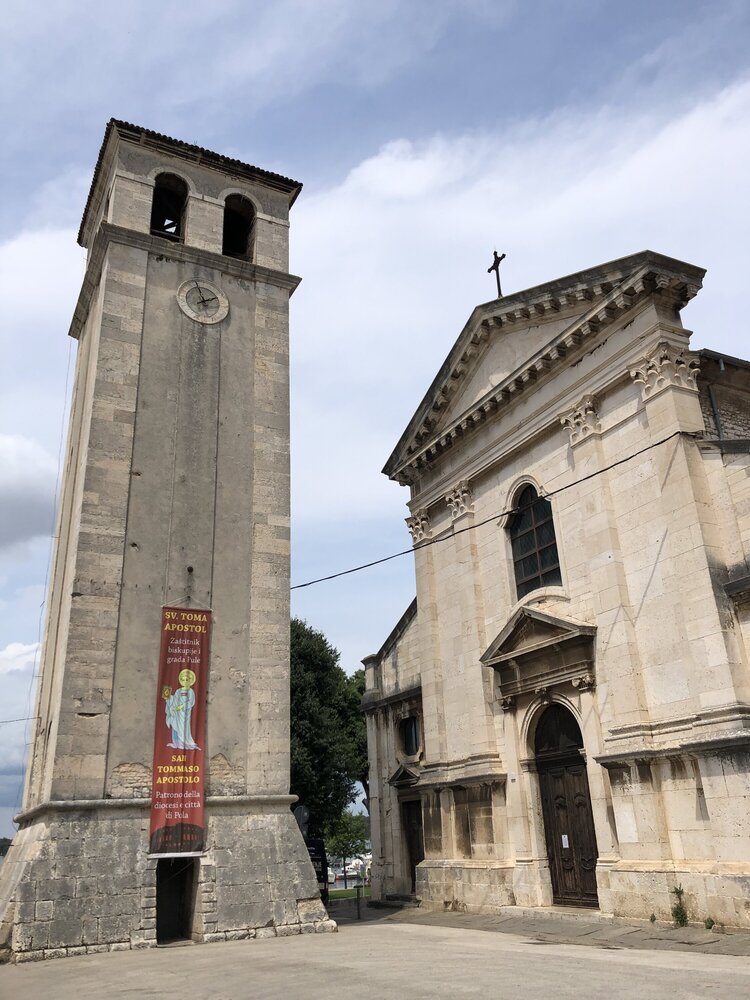
Augustov hram and Forum Square
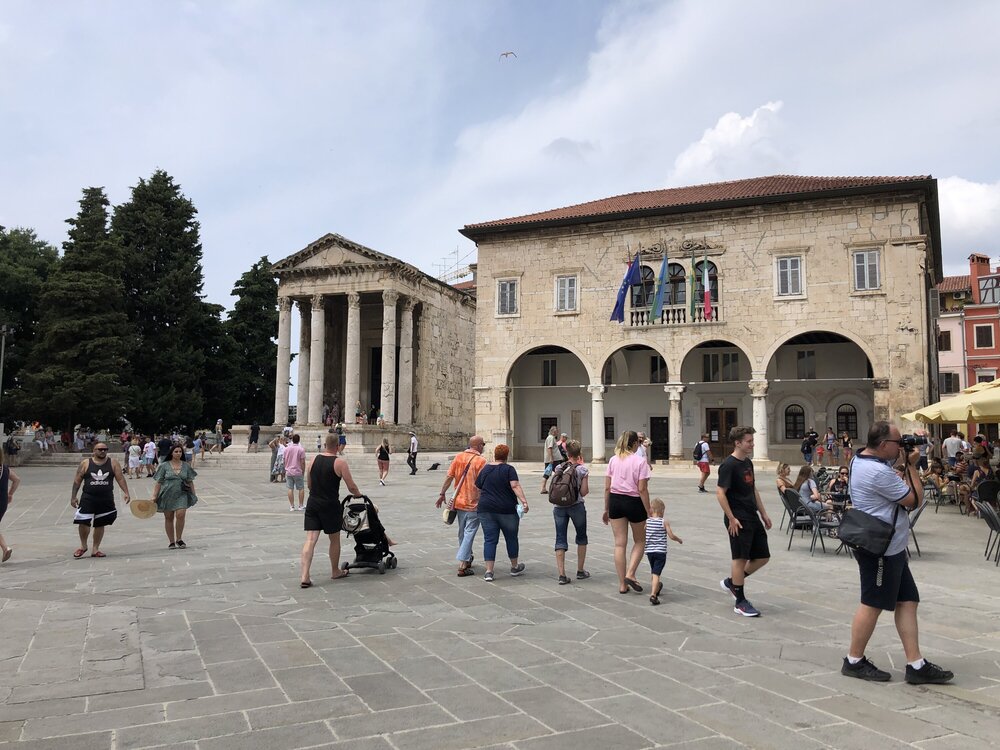
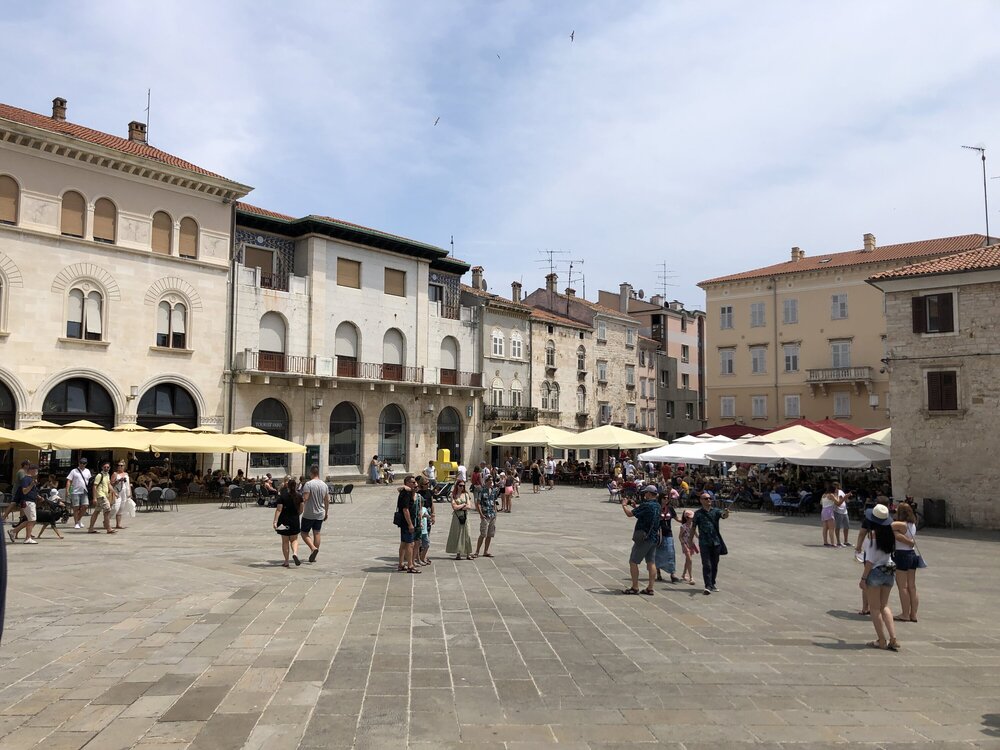
The Temple of Augustus is located in the lively Forum Square. For the third millennium, it has been a gathering place for locals and city events. This ancient Roman structure was built in honor of Emperor Octavian Augustus presumably during his reign and after his death — from 27 BC to 14 AD. The temple is a rectangular building measuring 8 by 17.3 m and 14 m high, erected on a podium. The facade is decorated with Corinthian columns, which have always been a striking attribute of Roman architecture.
It is the 2nd best preserved ancient Roman temple outside Italy (after Maison Carré in France). In the early 19th century the temple was used as a museum of stone monuments. During World War II, the temple was severely destroyed by bombing. Restoration works took place from 1945 to 1947. Today, inside the temple you can see a small exhibition of ancient sculptures made of stone and bronze. The exhibition is very modest, you can assess its scale from the threshold and decide whether you are interested in going inside.
- The opening hours of the Augusta Temple are 09:00 — 20:00.
- Entrance to the temple is 1,5 € (more accurately on the temple’s website).
Three temples once stood on this square, of which only the Temple of Augustus has survived. The other two became the basis for the Town Hall, built by the Venetians. To the right was the Temple of Diana, and its remains are clearly visible in the back wall of the Town Hall. And between the temples of Diana and Augustus was the temple of Jupiter, Juno and Minerva.
Agrippina’s House (Agripinina kuća)
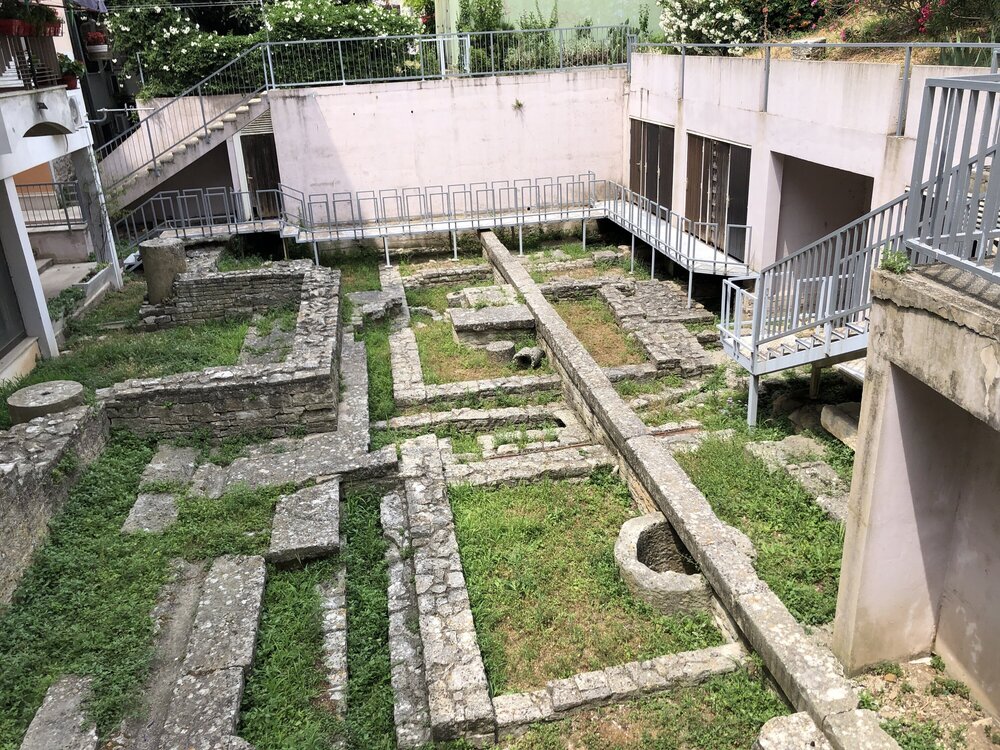
It is hard to imagine what the Forum looked like at the time of Christ, but you can look into the house that faces the square. Obviously, it was not a simple house with poor owners.
It is not known who lived in the house, but it bears the name of Agrippina because a bust of Queen Agrippina Minor (or the Younger), a Roman aristocrat who was the wife of Emperor Claudius, sister of Caligula and mother of Nero, who had her killed.
From the house, which was once richly decorated with frescoes and marble, only the foundations have survived. Part of it is in modern buildings, and a small fragment is on public display — free of charge and around the clock.
Archaeological Museum of Istria (Arheološki muzej Istre)
The Archaeological Museum of Istria shows the history of the peninsula from the time of primitive people to the Renaissance. The museum was founded in 1802, when the first collection of archaeological materials was gathered, and it was opened to the public in 1925, when the exhibits of the Regional Museum of Poreč were added to the already collected collections. Rows of valuable archaeological finds continue to be regularly replenished.
The entrance to the museum is a gate that served as the entrance to the ancient Roman city and was built between the 2nd and 3rd centuries. The museum’s collections of exhibits are organized by periods of history and are presented on 3 floors. The building itself is a former Austrian gymnasium with an area of 3600 square meters. Going around all the exhibits on offer is an intense task for a whole day. The museum also manages the arena, the temple of Augustus and the monastery in Nesactium.
You can find out the opening hours and cost of admission on the museum’s website. In 2021 it is closed for reconstruction, I was not able to enter it.
Church of St. Nicholas (Crkva sv. Nikola)
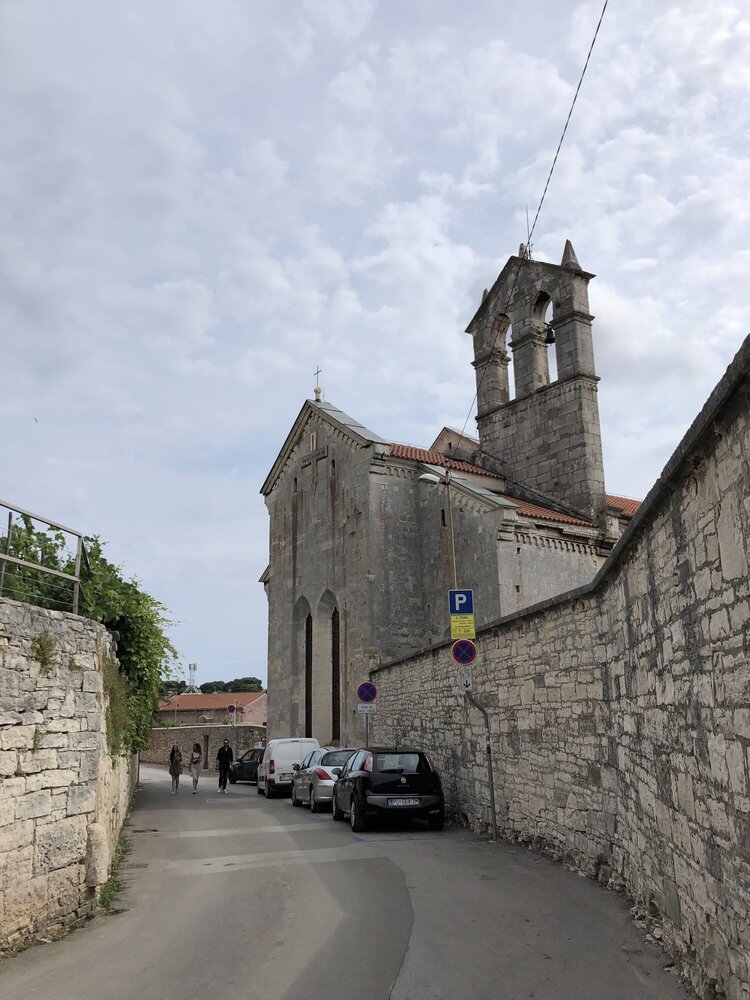
The first version of the Church of St. Nicholas the Wonderworker dates back to the late 6th century. In the course of history it was reconstructed several times and in the 16th century it was given to the Greek Orthodox community as we see it today. This shrine is located north of the Historical Museum and the fortress. Within its walls are numerous religious artifacts and iconostasis from the Middle Ages and Renaissance.
All the main attractions of the city — the arena, the fortress and many others — are within walking distance of the Church of St. Nicholas.
- The church is open to the public from 9:00 a.m. to 7:00 p.m. and until 3:00 p.m. on Sunday.
- Liturgy is available on Sundays at 9:00 am.
Church and Monastery of St. Francis (Crkva i samostan sv. Franjo)
This architectural complex of the Gothic style consists of a rectangular church with a square altar and the monastery of St. Francis. The idea of the building dates back to 1210, when Francis founded the Franciscan order, and the construction was completed in the late 70s of the XIII century.
The monastery is a structure with an elegant facade, courtyard and religious sculptures. The inhabitants of Pula revere this place, as the church houses the relics of Blessed Otto, who came to the city at the time of the monastery’s construction. In the chronicles of the Franciscan order, he is mentioned as a healer of the suffering and sick in the city.
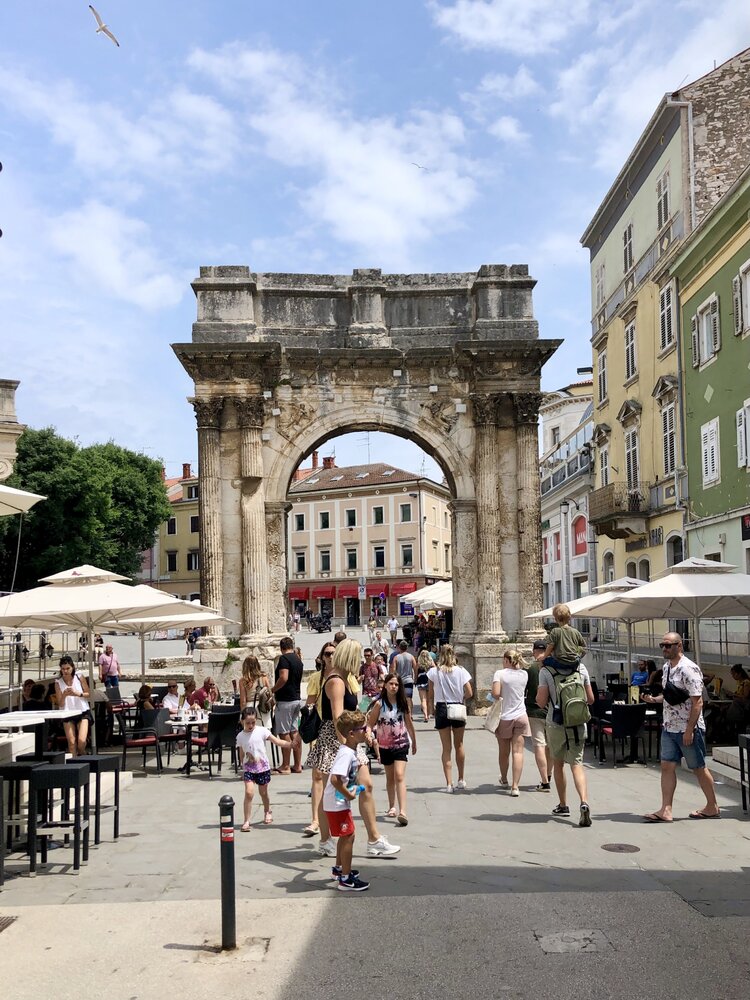
Triumphal Arch of Sergiev, or Golden Gate (Slavoluk Sergijevaca/Zlatna vrata)
This majestic structure was erected in 29—27 BC by the Sergius family in honor of its members who held high administrative positions in the city. The arch is only 8 meters high and the span is up to 4.5 meters wide. Compared to other arches of the Roman period, this arch is small, and it might have remained unknown, if not for an interesting feature: all other arches were erected in honor of emperors, but this one was built in honor of citizens. The western side of the arch is beautifully decorated, and it was this part that was the front to the city.
The arch is located on a small square where cultural events and theater performances are held. There are stores and many cafes around.
Chapel of St. Mary of Farmosa (Kapela sv. MarijA Formoza)
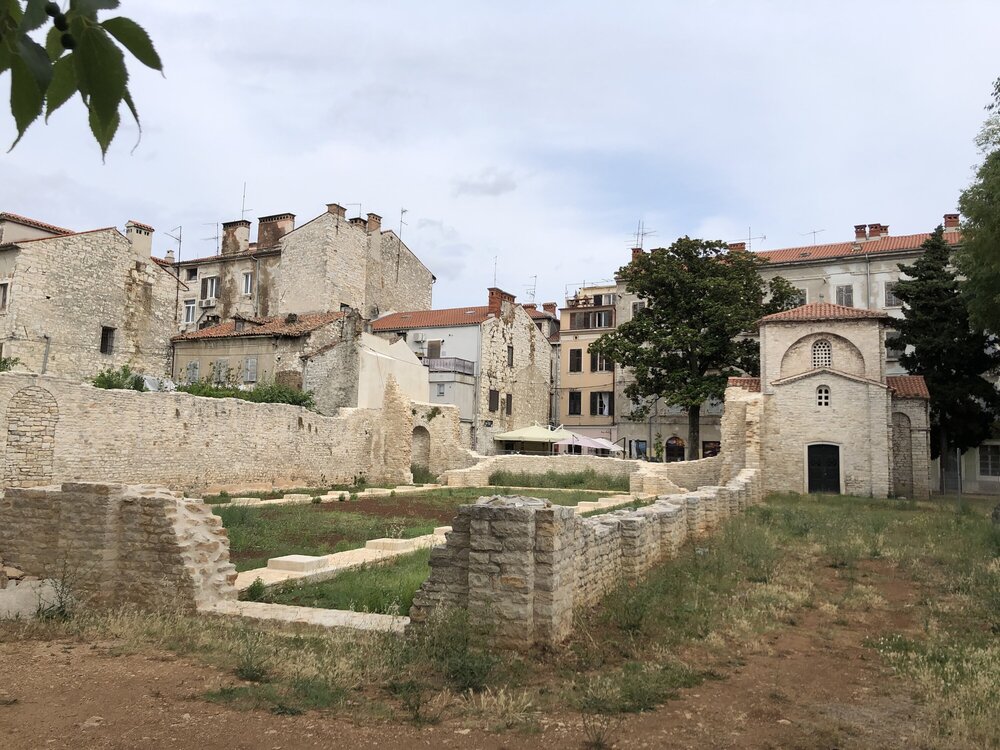
This modest sixth-century chapel is all that remains of the early Christian basilica of the same name, built by craftsmen from Constantinople and a large Benedictine abbey. In the XIII century during the Venetian conquest, the luxurious basilica burned down, its columns were taken to Venice, and only the chapel survived. The whole complex was abandoned and fell into disrepair, and this saved the chapel from later alterations. Today it is valued for the fact that this rare example of Byzantine architecture in Istria has survived intact since the 6th century.
The interior of the chapel is now accessible only when temporary exhibitions are held inside. Fragments of its floor mosaics are on display at the Archaeological Museum. But next to the chapel you can see the ruins of the abbey and imagine the size of the basilica. The remains of the neighboring northern chapel became the basis for later dwellings, and now there is a good Istrian restaurant there — its umbrellas can be seen in the photo behind the ruins.
Zerostrasse (Zerostrasse)
Pula’s most literally hidden attraction is underground: it is a network of World War II military tunnels under the castle hill. Zerostrasse is two cross tunnels with a total length of about 500 meters. There is an entrance at all four ends (only two of them are said to be open in winter).
The Austro-Hungarian Empire and then Austrian troops were based in Pula from the middle of the 19th century, and they dug these underground passages. During the war, the dungeon was used as a military headquarters and barracks. Now there is an exhibition in the tunnels.
Where to stay in Pula
The question of choosing a neighborhood in Pula fundamentally depends on the purpose of rest: walking around the city center or beach vacation. Pula is the main city of Croatian Istria, but it is small and there are not many sights. A day is enough for a walk around the historic center, another day can be devoted to museums — archaeological or, for example, the museum of olive oil. But to get to the beaches from the center is not very convenient. The historical center is quite far from the beach areas, so many tourists stay in the coastal outskirts of the city, and come to the center to walk in the evening or morning.
- For a beach vacation you should choose hotels further away from the center, near the coast of Pula. A room for two with breakfast in 3* Hotel Pula will cost 70 €, and in 4* Hotel Valsabbion on the first line with its own private beach — from 114 €.
- For walking around the city, I recommend staying on the outskirts of the historical center: the houses are modern and comfortable, and the historical sights are a couple of minutes away on foot. Near the Arena, an apartment for two people will cost 40—50 €, a 3* Amfiteatar hotel — from 70 € with breakfast.